
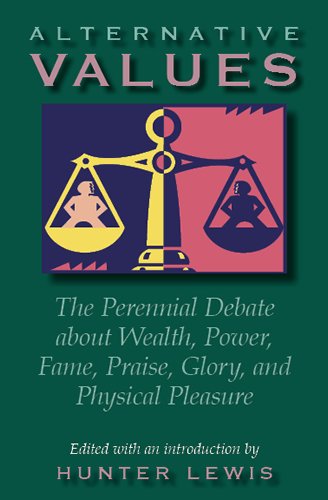
Alternative Values
The Perennial Debate About Wealth, Power, Fame, Praise, Glory, and Physical Pleasure
Edited with an introduction by Hunter Lewis
ISBN: 978-0-9661908-6-1
Alternative Values brings together in one place what people have said about the pursuit of wealth, power, fame, praise, glory, and physical pleasure over the centuries.
Available From:


Alternative Values brings together in one place what people have said about the pursuit of wealth, power, fame, praise, glory, and physical pleasure over the centuries. It is set up in the form of a debate: arguments that one should ardently pursue some of our most common desires are juxtaposed with arguments that pursuing them is a foolish or even tragic waste of one’s life.
In Plato’s Gorgias, Callicles argues that “The person who would truly live ought to allow personal desires to wax to the uttermost [and] when they have grown to their greatest . . . have the courage and intelligence to minister to them and satisfy such longings.” The Buddha, by contrast, warns that “From craving arises sorrow,” and Einstein agrees that “I am happy because I want nothing.” Epicurus provides a somewhat different perspective: “Personal pleasure [should be] the objective,” but the truest pleasure is “the absence of . . . turmoil in the mind.” Willa Cather counters that “There is only one big thing—desire,” and Bette Davis says proudly that “My passions were all gathered together like fingers that made a fist.” Thomas Hobbes agrees that “To have no desire is to be dead,” and Isaiah Berlin characterizes “the doctrine that . . . what I cannot have I must teach myself not to desire . . . [as] a sublime but unmistakable form of . . . sour grapes.”
This is truly a perennial debate, one that all of us must try to resolve for ourselves, but also a debate that can be enriched and clarified by paying close attention to what others have thought and said over the years.
Overview
-
Introduction
Wealth
Arguments against the Pursuit of Wealth
Basic Arguments
Philosophical Arguments
Arguments for the Pursuit of Wealth
Basic Arguments
Philosophical Arguments
Power
Arguments against the Pursuit of Power
Basic Arguments
Philosophical Arguments
Arguments for the Pursuit of Power
Arguments for the Pursuit of Power in Order to Do Good
Arguments for the Pursuit of Power in Order to Achieve Independence or Defend Oneself
Arguments for the Pursuit of Power for Its Own Sake
Fame
Arguments against the Pursuit of Fame
Basic Arguments
Philosophical Arguments
Arguments for the Pursuit of Fame
Basic Arguments
Philosophical Arguments
Praise
Arguments against the Pursuit of Praise
Basic Arguments
Philosophical Arguments
Arguments for the Pursuit of Praise
Basic Arguments
Philosophical Arguments
Glory
Arguments against the Pursuit of Glory
Basic Arguments
Philosophical Arguments
Arguments for the Pursuit of Glory
Basic Arguments
Philosophical Arguments
Pleasure (Physical)
Sex
Arguments against the Free Pursuit of Sex
Basic Arguments
Philosophical Arguments
The Special Case of Adultery
Arguments for the Free (or Fairly Free) Pursuit of Sex
Basic Arguments
Philosophical Arguments
The Special Case of Adultery
Drink
Arguments against the Free Pursuit of Drink (or Similar Pleasures)
Basic Arguments
Philosophical Arguments
Arguments for the Free Pursuit of Drink
Miscellany
Arguments against the Pursuit of Wealth and Power
Arguments for the Pursuit of Wealth and Power
Arguments against the Pursuit of Wealth and Fame
Arguments against the Pursuit of Wealth and Praise
Arguments against the Pursuit of Wealth, Power, and Pleasure
Arguments against the Free Pursuit of Sex and Drink
Arguments for the Free Pursuit of Sex and Drink
Index
-
ISBN-13: 9780966190861
Publication date: 02/27/2007
Pages: 190
Product dimensions: 5.30(w) x 8.05(h) x 0.59(d)
-
Related Reading


About the Author
Hunter Lewis
Hunter Lewis, co-founder of global investment firm Cambridge Associates, has written nine books on moral philosophy, psychology, and economics, including the widely acclaimed Are the Rich Necessary? (“Highly provocative and highly pleasurable.”—New York Times). He has contributed to the New York Times, the Times of London, the Washington Post, and the Atlantic Monthly, as well as numerous websites such as Forbes.com, Fox.com, RealClearMarkets.com, and Townhall.com. He has served on boards and committees of fifteen leading not-for-profit organizations, including environmental, teaching, research, cultural, and global development organizations.
