
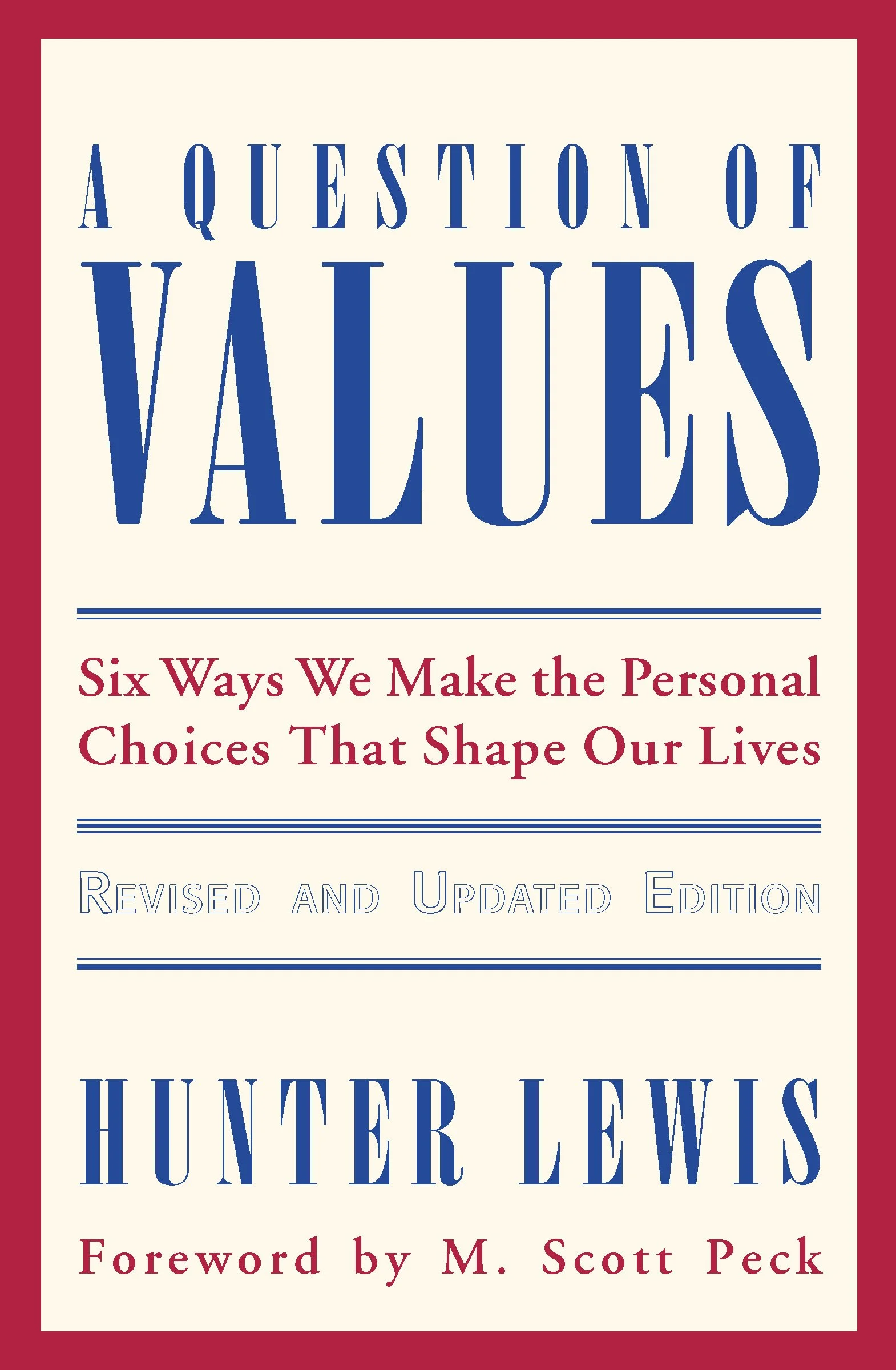
A Question of Values
Six Ways We Make the Personal Choices that Shape Our Lives
Author: Hunter Lewis; Foreword by M. Scott Peck
ISBN: 978-0-9661908-3-0
eISBN: 978-1-60419-070-0
A Question of Values explores how Americans form their beliefs through six competing value systems—authority, logic, experience, emotion, intuition, and science—using real-life case studies to help readers understand, clarify, and thoughtfully choose their own values.
Also Available From:


What are values? Do they truly exist? How do Americans formulate them? In this erudite and provocative book, Hunter Lewis explores the often conflicting value systems that compete for attention in American life. He constructs a framework by which six different American value systems—based on authority, logic, experience, emotion, intuition, and science—are defined and compared, thereby shedding new light on how we come to believe what we believe.
Wide-ranging, yet always accessible, A Question of Values provides seventy-one case studies of specific or composite value systems—Protestant fundamentalism, the Judaism of Golda Meir, the “detached action” of Mohandas Gandhi, and those of Spinoza, Mortimer Adler, Mikhail Gorbachev, Tennessee Williams, Thomas Merton, Sigmund Freud, Eudora Welty, Ronald Reagan, and Henry Kissinger, among many others.
“Confronted with the unexpectedness, diversity, and argumentativeness of American values, with the apparent lack of any real agreement or uniformity in our personal beliefs, the beliefs that guide our everyday speech and conduct and make us what we are, how should we respond?” Lewis asks. He then shows us a way to clear our mental clutter, to decide what our basic moral alternatives are, and “how each thinker or would-be prophet that we meet, either directly or through books and film, relates to these basic alternatives.”
Not only does Lewis illuminate our own values and those of others, he also helps us sort through a variety of social issues—for example, the way values should or should not be taught in the classroom, or the general problem of moral education in American schools and colleges. Lewis makes brilliant sense of the moral and ethical confusion of our times and discovers for us that “values are not the muddle they sometimes seem. There are some basic choices. . . . Our challenge as Americans and as human beings is to identify these options, and then to choose among them, not blindly but with a discerning eye, and thus to answer the recurring biblical question: ‘What manner of men shall we be?'”
Overview
-
Foreword by M. Scott Peck
Acknowledgments
Part One: Personal Values
1. The Initial Question
2. Sorting It Out: How We Choose Our Values
Part Two: Four Basic Mental Modes and the Value Systems Associated With Them
3. Value Systems Based on Sense Experience
4. Value Systems Based on Logic
5. Value Systems Based on Emotion
6. Value Systems Based on Intuition
Part Three: Two of the Most Important Synthetic Mental Modes and the Value Systems Associated With Them
7. Value Systems Based on Authority
8. Value Systems Based on “Science”
Part Four: Variations on a Theme (Including Other Examples of Synthetic Value Systems)
9. The Cross-Fertilization of Values
10. Four Highly Personal SyntheticValue Systems Closely Linked to Traditional Religions and
Grounded Either in Emotion or Sense Experience: Barth, Einstein, Gandhi, Meir
11. Why Values Get So Complicated
Part Five: Values in the Classroom
12. Teaching Directly about Values
13. Political Value Systems or Ideologies (Taught, Reflected, or Alluded to in Undergraduate Courses) That Express Sense Experience, Logic, and Especially Emotion
14. Economic Value Systems or Ideologies (Taught, Reflected, or Alluded to in Undergraduate Courses) That
Express Sense Experience, Logic, and Especially Emotion
15. Philosophical Value Systems (Taught, Reflected, or Alluded to in Undergraduate Courses) That Express Logic Plus
16. Value Systems Associated with Literary Criticism (Taught, Reflected, or Alluded to in Undergraduate Courses) That Express Sense Experience Plus
Part Six: Epilogue
17. A Personal Note
A Short Encyclopedia of Value Systems Including 74 Value Systems Described in This Book
Sources
Sources Keyed to the Text
Index
-
ISBN-13: 9780966190830
Publication date: 02/27/2007
Pages: 295
Edition: Revised and Updated Edition
Product dimensions: 5.36(w) x 8.09(h) x 0.73(d)
-
Reviews
“Not only teaches us how to think about values; it teaches us how to think. This book should be required reading in schools.”
A. Bartlett Giamatti, former president of Yale University and Commissioner of Baseball
“We live in a world in which individual choice is often complex and difficult. Hunter Lewis lucidly and evenhandedly provides a framework for reflecting upon the different value systems that underpin the decisions each of us must make.”
Kathryn S. Fuller (President, World Wildlife Fund)
“Enormously worthwhile….provides a unique way of organizing our thinking about values.”
Adele Simmons (President, MacArthur Foundation)
-
“An important book.”
Henry Rosovsky (former Dean of Arts and Sciences and currently Lewis P. and Linda L. Geyser University Professor Emeritus, Harvard University)
——
“A brilliant work on what is by far the most important topic in modern politics, philosophy, economics, and psychology—namely values.”
Ken Wilber (Editor, New Science Library, and author of Transformation of Consciousness)
——
“A stimulating book if ever there was one…an eye opener.”
Dorothy B. and Homer A. Thompson (Institute for Advanced Study, Princeton, New Jersey)
——
“Especially useful…to help students…in actual human decision-making.”
Harvey Cox (Professor of Divinity, Harvard University, author of Many Mansions and The Secular City)
——
“An important book for advertising and marketing professionals.”
Bruce Crawford (President and CEO, Omnicron, Inc.)
——
“In today’s environment, leaders of business must understand and respond to human values if their institutions are to survive and prosper. I highly recommend Hunter Lewis’s book.”
James R. Houghton (former Chairman and CEO, Corning, Inc.)
Related Reading

About the Author
Hunter Lewis
Hunter Lewis, co-founder of global investment firm Cambridge Associates, has written nine books on moral philosophy, psychology, and economics, including the widely acclaimed Are the Rich Necessary? (“Highly provocative and highly pleasurable.”—New York Times). He has contributed to the New York Times, the Times of London, the Washington Post, and the Atlantic Monthly, as well as numerous websites such as Forbes.com, Fox.com, RealClearMarkets.com, and Townhall.com. He has served on boards and committees of fifteen leading not-for-profit organizations, including environmental, teaching, research, cultural, and global development organizations.
