
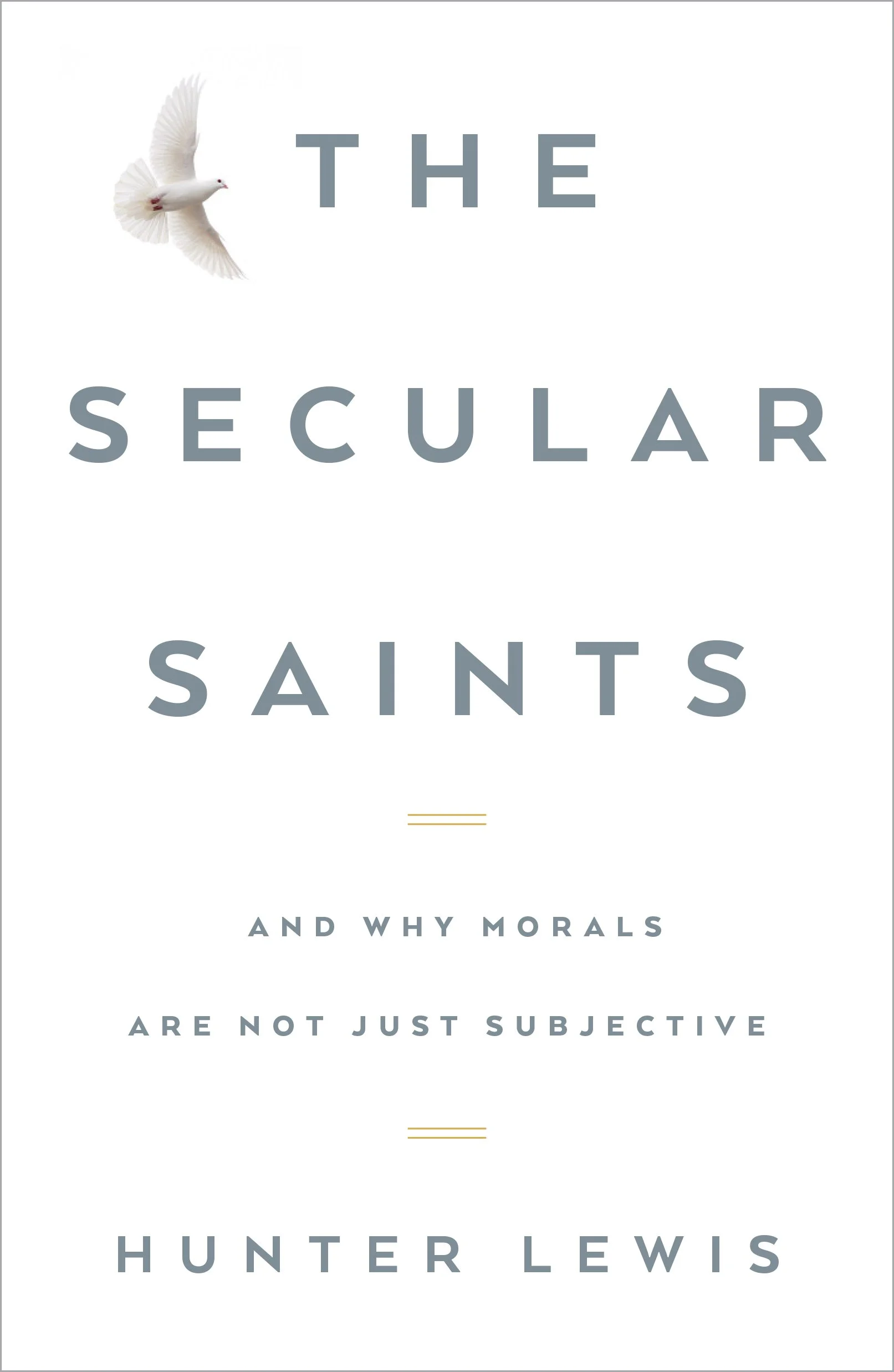
The Secular Saints
And Why Morals Are Not Just Subjective
Author: Hunter Lewis
ISBN: 978-1-60419-118-9
eISBN: 978-1-601419-119-6
This book examines the lives and ideas of influential moral thinkers, addressing whether ethics are objective or subjective. It argues that morals are grounded in objective reality, offering guidance on what is truly right and wrong beyond religious frameworks.
Also Available From:


The term “secular saint” may immediately raise questions or even objections. Each religion specifies grounds for being considered a saint. What does it mean to be a secular saint? Presumably an exemplary life. But exemplary based on what? Exemplary according to whom? Perhaps an exemplary life is not even enough to qualify. Perhaps the life must also be inspiring or have something to teach us. But, again, inspiring or instructive according to whom?
These questions are variants of the perennial question: are ethics and moral objective in some way or completely subjective? Is anybody’s opinion worth hearing? Most people would agree that Hitler’s morals were horrendous. But is there a way to distinguish good from bad without reliance on revealed religion?
All of this in turn leads to questions humans have always asked themselves. What is right or wrong? What is good or bad or just less good? What is just or unjust? These are not just questions for confused or searching teenagers. Human beings are guided day by day by our beliefs and values, and are absolutely lost without this kind of guidance.
This book provides “brief lives” and thoughts of some leading candidates for the term secular saint. Many of them are famous moral philosophers. Taken together, they offer a kind of history of moral thought. Some of them are not what we would today consider philosophers. All of them have much to teach us about how we lead our lives and think about the fundamental questions.
This book also offers a conclusion: that morals and ethics are not just subjective, that they are grounded in very objective realities. There is such a thing as right and wrong, better and worse, and as thinking creatures we should recognize this and act on it.
Overview
-
Part One: Introduction
Are Morals Subjective?
Part Two: Ancient Moral Thinkers
Socrates (469–399 BCE)
Aristotle (384–322 BCE)
Epicurus (342–270 BCE)
Epictetus (55–135 CE)
Part Three: Modern Moral Thinkers
Desiderius Erasmus (1466–1536)
Michel de Montaigne (1533–1592)
Baruch de Spinoza (1632–1677)
David Hume (1711–1776)
Adam Smith (1723–1790)
Immanuel Kant (1724–1804)
Edward Gibbon (1737–1794)
Jeremy Bentham (1748–1832)
Part Four: Modern Moral Thinkers and Doers
Jane Addams (1860–1935)
Ludwig von Mises (1881–1973)
Eudora Welty (1909–2001)
Edna Lewis (1916–2006)
Part Five: Conclusion
Why Morals Are Not Just Subjective
Endnotes
Index
-
ISBN-13: 9781604191189
Publication date: 03/06/2018
Pages: 435
Product dimensions: 5.60(w) x 8.10(h) x 1.50(d)
-
“[This is] . . . a book which, much like an excellent dinner party, gathers interesting personalities and invites them to engage with one another—in this case over the perennial question of how an individual is to lead a good life, a moral life. . . . Different guests sparkle to varying degrees . . . . Among the philosophers, Montaigne positively dazzles with the appeal of a bon vivant. . . .”
Reverend Stephen McCarthy ’06 | Groton School Quarterly (Fall 2018)
Reviews
“Hunter Lewis has set himself a difficult task . . . in this rich book . . . : he endeavors to explain why morals are not subjective . . . [and] offers portraits of remarkable people. . . . [He] looks to David Hume . . . , Ludwig von Mises . . . , and . . . Henry Hazlitt as . . . precursor[s] of . . . his approach. One cannot read . . . this . . . book without being impressed by the author’s philosophical acumen, scholarship, and humanity.”
David Gordon, Senior Fellow at the Mises Institute, and editor of The Mises Review | Mises Wire (May 19, 2018)
“The Secular Saints: And Why Morals are Not Just Subjective examines the lives of Socrates, Aristotle, Adam Smith, Immanuel Kant, and many more in search of a better understanding of the value of morals and ethics, both individually and in a collective society. Inspirational and thought-provoking, The Secular Saints is a welcome contribution to both personal and public library philosophy collections.”
-
Complete review from Reverend Stephen McCarthy ’06, Groton School Quarterly(Fall 2018)
“What is a chef doing among the intellectual luminaries, authors, and Nobel Prize winners collected in The Secular Saints: And Why Morals are Not Just Subjective? Following chapters exploring the thought of Aristotle, Spinoza, and Ludwig von Mises, among others, the inclusion of chef Edna Lewis (no relation to the author) came as something of a surprise.
For those unfamiliar with her (as I was before reading this book), Edna Lewis did more than anyone to put the cuisine of the American South at the forefront of the American culinary scene. And if you share doubts of the kind I once had as a New Englander dispatched to Alabama for his first job after seminary, I can assure you hers is an enduring legacy; just this year the James Beard Foundation named Highlands Bar & Grill, a Birmingham restaurant with a gourmet take on Southern classics, the most outstanding in America. Yet, in an important way, Edna Lewis’ labor and distinguished life are perhaps most suited to a book which, much like an excellent dinner party, gathers interesting personalities and invites them to engage with one another—in this case over the perennial question of how an individual is to lead a good life, a moral life.
Hunter Lewis does not limit his invitation to “secular sainthood” to those with animosity toward revealed religion—indeed, several of those featured expressed Christian commitments. Rather, he makes his criteria that they lived their lives and expressed their thoughts in ways independent of organized religion. Collectively, the author poses this motivating question: “Is it possible to establish a credible moral, ethical, philosophical system outside of religion? And if so, what would it look like?” The human tendency to seek group identity through adversarial self-definition, or what Mr. Lewis calls “tribalism,” has given rise to an environment in which this project feels especially pressing. The public has a strong appetite for such exploration—whether approached from the right, as by University of Toronto Professor Jordan Peterson, or from the mainstream left, as by Columbia Professor Mark Lilla. TheSecular Saints has a distinctive contribution to make to this discussion, firmly situated as it is in the tradition of classical liberalism.
The Secular Saints does not merely introduce various figures and their biographies; more often than not, it introduces salient quotations from their own writings. The ad fontes spirit of this approach should feel familiar to Grotties of all generations. The result is that, like at any good dinner party, different guests sparkle to varying degrees, often depending more on the incidentals of company and conversation than on their innate character. We can also thus encounter them in unexpected ways, as when we discover economist Adam Smith on the defensive, or hear philosopher David Hume expound on economics and religion, rather than epistemology more generally. Among the philosophers, Montaigne positively dazzles with the appeal of a bon vivant; and Epicurus speaks with the same verve Mr. Tulp communicated when I first encountered him by way of Lucretius in Fourth Form Latin; while Immanuel Kant remains as implacably earnest and Teutonic as he ever was in Mr. Seeley’s Sixth Form Ethics course.
Establishing the objectivity of morality is a tall order for any volume; and, while advocating for this, The Secular Saints leaves it up to the individual reader to draw conclusions about details—befitting its classical liberal affinities, and whetting the reader’s appetite for more. Happily, the first chapter offers a concise introduction to some of the leading ethical theorists of the present. However, with the exception of Alasdair MacIntyre, the book passes over those whose approaches are more engaged with the Christian tradition (e.g. Nicholas Wolterstorff, Charles Taylor). Those stimulated to seek further programmatic treatment of these themes might turn to Hunter Lewis’ A Question of Values: Six Ways We Make the Personal Choices That Shape Our Lives; or the Dutch legal theorist Andreas Kinneging’s The Geography of Good and Evil. Accepting the invitation to spend time with The Secular Saints affords readers the opportunity to meet interesting historical personalities whose relevance is undiminished today.”
Related Reading

About the Author
Hunter Lewis
Hunter Lewis, co-founder of global investment firm Cambridge Associates, has written nine books on moral philosophy, psychology, and economics, including the widely acclaimed Are the Rich Necessary? (“Highly provocative and highly pleasurable.”—New York Times). He has contributed to the New York Times, the Times of London, the Washington Post, and the Atlantic Monthly, as well as numerous websites such as Forbes.com, Fox.com, RealClearMarkets.com, and Townhall.com. He has served on boards and committees of fifteen leading not-for-profit organizations, including environmental, teaching, research, cultural, and global development organizations.
